


Supply chain due diligence in international organization documents
In practice, supply chain due diligence regulations first appeared in documents of international organizations (mostly intergovernmental). These typically consist of non-binding recommendations that are widely agreed upon and serve as high-value references, providing guidance for governments of member states.
Below is a brief introduction to the international organization documents considered as foundational frameworks for supply chain due diligence regulations worldwide.
1. UN Guiding Principles on Business and Human Rights (2011)
UN Guiding Principles on Business and Human Rights (UNGP), adopted by the United Nations Human Rights Council in June 2011, are widely recognized by experts as the first foundational legal document underpinning supply chain due diligence regulations globally.
The UNGP sets out 31 core principles to protect human rights, applicable to both governments and enterprises. Among these, five principles in the section dedicated to enterprises specifically address various aspects of corporate supply chain due diligence concerning human rights (human rights due diligence).
The UNGP contributed to the development of supply chain due diligence regulations worldwide in two main aspects:
- For the first time, introduced the term “due diligence”: This term, along with its corresponding content, was subsequently widely used in documents on supply chain due diligence.
- For the first time, outlined the basic steps of due diligence (including policy integration, risk identification and assessment, implementation of measures to address risks, monitoring the effectiveness of actions taken, and public disclosure of related information): These steps later became core components of supply chain due diligence processes in the regulations of many countries and organizations.
However, in terms of the scope of due diligence, the UNGP limits corporate responsibility to human rights aspects only. Environmental and other aspects are not addressed in this document. After the UNGP, subsequent international and national documents were developed, creating a wave of codification of corporate supply chain due diligence responsibilities.
2. OECD Guidelines for Multinational Enterprises on Responsible Business Conduct (2011)
Immediately following the adoption of the UNGP, the Organisation for Economic Co-operation and Development (OECD) updated the content in its OECD Guidelines for Multinational Enterprises on Responsible Business Conduct and simultaneously issued the OECD Due Diligence Guidance on Responsible Business Conduct. Similar to the UNGP, the OECD due diligence guidance is non-binding and provides recommendations.
The OECD due diligence guidance is regarded as the most comprehensive framework for supply chain due diligence, considering both the scope of enterprises (multinational enterprises - MNEs), the areas of due diligence (covering not only human rights but also other aspects), and the due diligence process (following the steps set out in UNGP, but adapted to practical business operations).
Figure: Supply chain due diligence process for MNEs according to OECD guidance
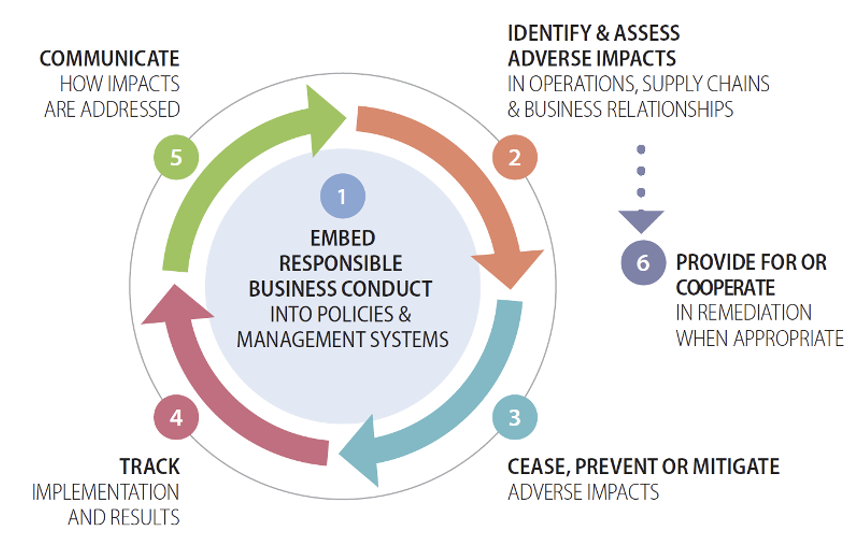
Source: OECD Due Diligence Guidance on Responsible Business Conduct
|
Due diligence standards in OECD guidance Since its issuance in 2011, the OECD Due Diligence Guidance on Responsible Business Conduct has been continuously updated, primarily to expand the scope of standards that enterprises must implement. Starting from the initial focus on human rights (including labour rights) and environmental aspects, subsequent updates have broadened due diligence standards to cover social aspects such as anti-corruption and bribery, consumer information and rights, competition, taxation, etc. The 2023 update further added aspects such as climate change, biodiversity, and technological safety. |
3. The ILO Tripartite Declaration of Principles concerning multinational enterprises and social policy
Supply chain due diligence responsibilities under the UNGP model were incorporated (in the March 2017 revision) into the ILO Tripartite Declaration of Principles concerning multinational enterprises and social policy).
This ILO declaration provides guidance on the due diligence process for MNEs from the perspective of labour rights.
According to the declaration, MNEs have a responsibility to conduct supply chain due diligence in labour rights, aiming to ensure decent work, sustainable business practices, inclusive growth, and equitable sharing of benefits from foreign investment.
Source: Compiled by the TTWTO-VCCI Research Group