


Consumer characteristics in Australia
The majority of Australians are in the high-consumption age group (15 to 64 years old), accounting for 64.8% of the country's population (World Bank 2023). Australians live mainly in South Australia and major coastal cities such as Sydney, Melbourne and Brisbane...
With an income level among the highest in the world (61,341 USD/person in 2023), Australian consumers have a high ability to pay for consumer goods. Australians' demand for consumer products is very diverse, from essential goods (such as energy, food, clothing, shoes...) to entertainment and luxury products (such as jewelry, vehicles, technology products...).
Main consumer products
According to OECDStat 2022, Australian consumers spend up to 23.2% of their total spending on housing, electricity, water, gas and other fuels. Next, Australians spend 10.6% on transportation/transportation, 10% on food and beverages... Thus, nearly half of Australians' total spending is on essential products, serving personal needs for food, accommodation and travel.
In addition, Australian consumers also pay great attention and spend a lot on products/services for entertainment purposes, providing experiences/enjoyment. Specifically, people in this country spend 10.4% on culture, entertainment and 7.5% on restaurants and hotels.
Table 1: Common consumer goods and services in Australia in 2022
|
Consumer goods/services |
Percentage in total expenditure of consumers |
|
Housing, water and electricity, natural gas, and other fuels |
23,2% |
|
Transportation |
10,6% |
|
Culture and leisure |
10,4% |
|
Food and non-alcoholic beverages |
10,0% |
|
Restaurants and hotels |
7,5% |
|
Health |
7,0% |
|
Furnishings, household equipment and everyday maintenance of the house |
4,7% |
|
Alcoholic beverages, tobacco and narcotics |
3,7% |
|
Clothing and footwears |
3,9% |
|
Education |
3,5% |
|
Communication |
1,9% |
|
Other goods and services |
13,6% |
Source: OECDStat, 2023
Consumption trends in Australia
Australian consumers have high demands for the standards and quality of consumer goods, so Australian people's purchasing decisions are greatly influenced/dominated by the quality as well as the image/brand of the product. However, price still plays an important role in Australian consumers' purchasing decisions.
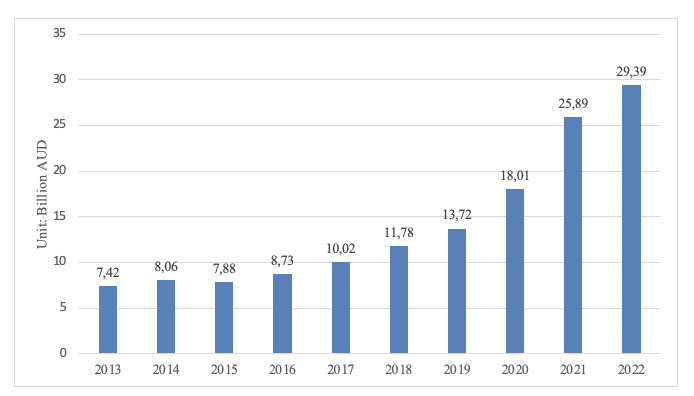
E-commerce is growing rapidly in Australia as people tend to switch to online shopping through websites/retail channels such as Amazon Australia, eBay Australia, Kmart Online... since the outbreak of the COVID-19 pandemic. E-commerce sales in Australia have increased fourfold in the past decade, from AUD 7.42 billion in 2013 to AUD 29.39 billion in 2022 (Statista.com, 2024).
Figure 1: E-commerce sales in Australia 2013-2022
Source: Statista.com, 2024
Australian consumers have a habit of searching and analyzing products carefully before making a purchase decision. They often use social media as a useful tool to search for new products, search for product information through previous users' feedback and compare prices between similar products...
In addition, Australian consumers are also very concerned about environmental issues, so organic and natural products, especially vegetables, are increasingly popular in Australia. For commercial and environmental purposes, the second-hand market is also very developed in Australia. The value of used goods has increased significantly since 2019, increasing from 43 billion AUD to 63 billion AUD in 2022 (statista.com, 2023).
Source: Center for WTO and International Trade
