



Indonesia's market size
Indonesia is the largest economy in Southeast Asia and the fifth largest economy in the RCEP, with total GDP reaching USD 1.4 trillion in 2024.
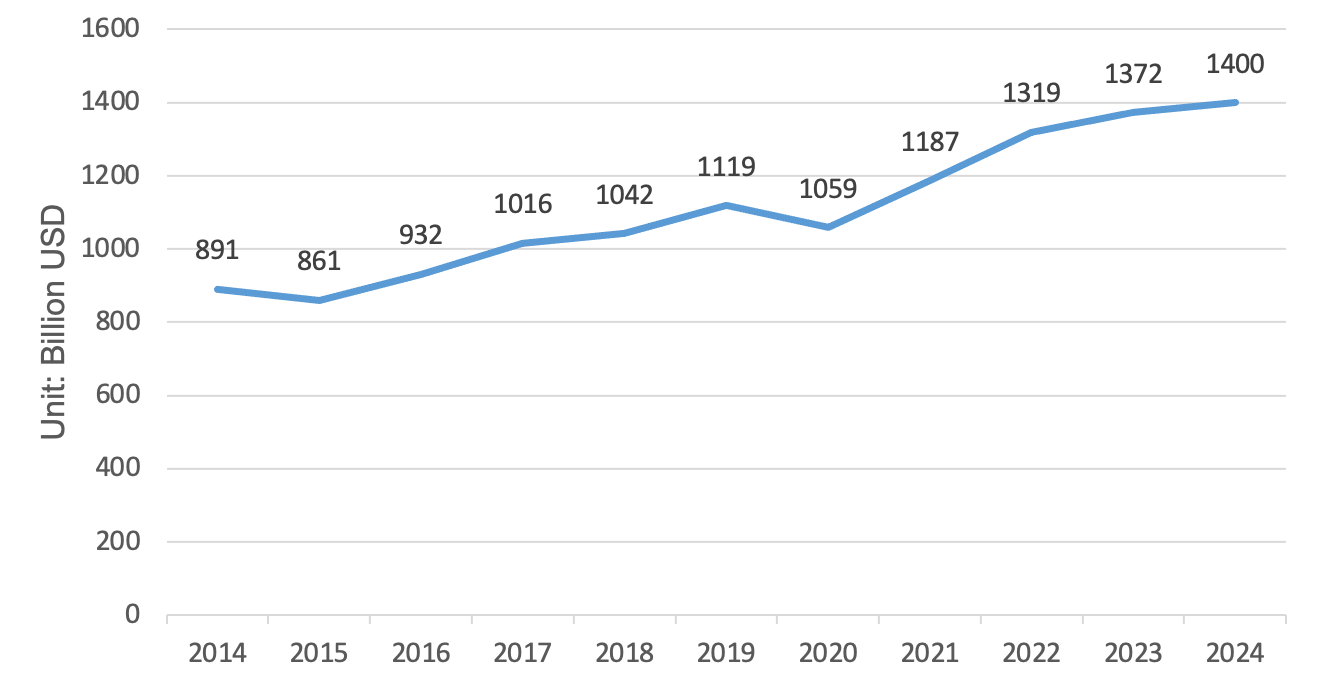
Over the past decade, Indonesia's economy has recorded significant growth, with GDP rising from USD 890.8 billion in 2014 to USD 1.4 trillion in 2024, equivalent to an average annual growth rate of 5% - substantially higher than the global average growth rate of 2.9% over the same period. The expansion of Indonesia's economic scale has also been driven in large part by strong domestic consumption in that market.
When COVID-19 broke out in 2020, Indonesia was also adversely affected, causing GDP to decline by 2.1% compared with 2019. Indonesia's economy then recovered rapidly and rebounded. By 2024, Indonesia's GDP had reached USD 1.4 trillion, nearly 23% higher than the pre-pandemic level.
Figure: Indonesia's GDP, 2014-2023
Source: World Bank Data, 2025
Indonesia's economy in recent years has been regarded as relatively stable, with macroeconomic indicators such as inflation and unemployment remaining relatively low and stable. Over the 2014-2024 period, Indonesia's average inflation rate was 2.2% and its average unemployment rate was 3.3% (World Bank data / ILO modeled unemployment estimate).
In terms of population size, Indonesia is the fourth most populous country in the world, with 283.4 million people (according to World Bank data for 2024). It therefore possesses a vast domestic consumer market with strong demand and substantial room for export expansion.
Source: Center for WTO and International Trade - VCCI
