


Most viewed articles


German chancellor and EU leaders baffled and frustrated as they await UK’s next move
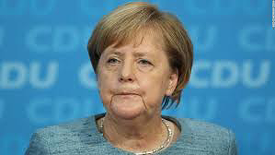
The German chancellor, Angela Merkel, has said she will fight until the “final hour” of 29 March to avoid a no-deal Brexit, but admitted she cannot second-guess the outcome of an EU summit this week due to the chaos in Westminster.
Following the decision by the Speaker of the House of Commons, John Bercow, to effectively block the UK government from putting Theresa May’s deal to MPs, Merkel expressed her surprise.
She said it was up to the British prime minister to tell the EU what was now required, but the “flux” in UK politics made it impossible to predict how the saga would develop.
The EU is expected to come to an agreement on the length of a Brexit delay with May on Thursday and leave it open to be formally signed off until the last hour of 29 March, allowing time for a further vote on the prime minister’s deal.
Speaking in Berlin, Merkel said: “I admit that I wasn’t on top of the British parliament’s 17th-century procedural rules.
“Now we’ll have to see what Theresa May tells us, what her demands are – and we will try to react to that. But this is not the case of an agreement that we negotiated alone, but that the British government approved.
“The agreement was supplemented just a few days ago, and I think substantially, because the wish was for something that was legally binding with regard to the backstop.
“So we’ll be watching very closely how the British government responds to what was said yesterday in the parliament and then respond to the situation. I can’t assess how things will be on Thursday, far too much is in flux.”
The British prime minister will formally seek to delay Brexit past 29 March at the summit on Thursday, but the lack of a Commons vote this week will leave little nailed down by the time the 27 heads of state and government discuss the issue.
The EU has repeatedly asked the British government to have a clear reason for an extension ready by the time of this summit.
It is likely, however, that the leaders will agree on a nine-month extension on condition that European elections are held – with an option to leave after three months without British MEPs being elected if the deal is ratified next week.
Merkel declined to comment on the length of the extension, which will have to be unanimously agreed by the 27 heads of state and government.
“I will fight until the final hour of the deadline of March 29 that we have an orderly exit,” she said. “We don’t have a lot of time for that, but a few days, and I can’t foresee how I’ll be placed on Thursday – that will all depend on what Theresa May puts forward, what the situation is, what happens in parliament, and then we the 27 will respond adequately and jointly.”
Merkel added that she respected the Commons. “We know where the hammer hangs,” she said, in reference to parliament having the final say on any deal.
A European commission spokesman said: “We are now exactly 10 days away from the United Kingdom withdrawing from the European Union.
“We naturally follow all developments in the House of Commons very closely, but it is not for us to comment on or intervene in the parliamentary process or parliamentary conventions of the United Kingdom. It will be for the prime minister and her majesty’s government to decide on the next steps and inform us accordingly and swiftly.”
The latest chaos in Westminster nevertheless prompted complaints of exhaustion from Merkel’s European affairs minister and some gentle mockery by the French, as EU ministers gathered to discuss a potential delay to Brexit at a meeting in Brussels earlier in the day.
The German EU affairs minister, Michael Roth, appeared visibly irritated when speaking to reporters, describing the mood in EU capitals as “very bad” ahead of a briefing by the bloc’s chief negotiator, Michel Barnier.
“We’re really exhausted by these negotiations and I expect clear and precise proposals of the British government why such an extension is necessary,” he said. “It’s not just a game, it’s an extremely serious situation, not just for the people in the UK, but also for the people in the EU, and for my government, it’s the key priority to prevent a no-deal Brexit.”
The French EU affairs minister, Nathalie Loiseau, who it emerged on Monday has named her cat Brexit due to its indecision and reluctance to leave the house, said it was necessary to “have a sense of humour” given the state of the process.
Asked whether the French president, Emmanuel Macron, would insist on strict terms for any extension, Loiseau told reporters: “It’s not a question of really strict conditions. We need something new [from the UK] because, if it’s an extension to remain in the same deadlock, how do we get out of this? The Brits have to come with an initiative [that is] clear, credible and supported by a majority.
“It’s a choice to be made by the UK. They’ve said no to a no-deal and no to a realistic deal. They have to change their minds on one of the two options. If there’s no decision, and the 29th comes, then it’s no deal. If Britain decides on nothing then it chooses no deal.”
The Romanian EU affairs minister, George Ciamba, whose country holds the rolling presidency of the council of the EU and organises the summits and meetings, suggested the Speaker’s move had unravelled the strategy. “There is less clarity than there was yesterday,” he said.
EU officials believe Bercow’s call for the deal to be “fundamentally” changed before it is put back to the Commons will be satisfied by a change in the UK’s exit date if it is agreed at the summit.
Source: The Guardian