


Taiwan needs to diversify away from China: minister
31/10/2022 86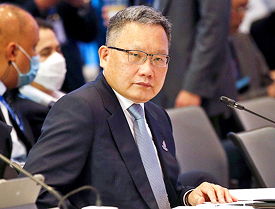
Most viewed articles


Taiwan needs to diversify its trade away from China, Minister of Finance Su Jain-rong (蘇建榮) said, citing uncertainties created by China’s “zero COVID-19” policy, and rising geopolitical tensions between Washington and Beijing.
The recent US technology curbs imposed on China have “increased the uncertainty of the market,” Su said in an interview on Friday, after the APEC finance ministers’ meetings in Bangkok.
He added that one of Taiwan’s goals is to “try to diversify our trade partners, our trade market, so that we are not going to put all our eggs in one basket.”
Taiwan’s trade has been pressured this year by waning demand from China and around the world, which has weighed on the export-dependent economy. Overseas shipments contracted last month for the first time since 2020, while export orders declined for the third time this year.
Officials have largely attributed the drop-off to China as COVID-19 restrictions and a property slump are depressing consumer and business confidence there.
Escalating US-China tensions have further clouded Taiwan’s outlook and rattled the global semiconductor industry. After the US announced tighter controls over chip exports to China this month, shares in Taiwan Semiconductor Manufacturing Co (TSMC, 台積電) fell the most in 28 years. TSMC makes chips for major companies that rely on the Chinese market for much of their business, while also taking in about 10 percent of its own revenue from China-based customers.
Su said he had not talked formally last week with US Deputy Secretary of the Treasury Wally Adeyemo, but said he thinks both sides are looking at the US-China relationship.
“The United States is concerned about the supply chains of advanced chips,” he added.
Taiwan’s exports to China and Hong Kong have declined over the past couple of years due to COVID-19 restrictions and US-China disputes, slipping below 40 percent of Taiwan’s total exports, the minister said.
Su said Taiwanese businesses have already started relocating factories from China to Southeast Asia — not so much in the semiconductor industry, but in machinery and other labor-intensive sectors.
Vietnam and Thailand are targets, he added.
Taiwan has been looking to diminish its dependence on China in the past few years, and has explored ways to bolster trade and investment with Southeast Asia, India, Australia and New Zealand.
Taipei last year asked to join one of the Asia-Pacific’s biggest working trade deals, although its application is still pending.
The minister also said Taiwan is looking “very carefully” at how to manage financial stability, as the New Taiwan dollar has weakened this year and as the benchmark TAIEX has tumbled nearly 30 percent so far this year.
The TAIEX closed up 0.29 percent yesterday after gaining as much as 1.6 percent earlier, the first gain in four days, after short-selling curbs were implemented.
Global funds have pulled a net US$47 billion from local equities this year, putting Taiwan on track for its biggest annual outflow in more than two decades.
The US Federal Reserve’s interest rate hikes cause “a lot of problems for financial markets around the world, not just Taiwan,” Su said.
Another issue is the increasing costs of imports — as Taiwan brings in a lot of its raw materials from abroad, imported inflation is another risk, he said.
Should the Fed continue raising rates, the “Taiwanese dollar and financial stability may be affected significantly,” Su said. “It’s not easy to handle it, but we have to face it.”
Source: Bloomberg
- National traceability system for agro-forestry-fishery products to be launched on July 1
- European Parliament backs long-awaited digital euro to reduce US dominance in payments
- A decade after Brexit, Britain weighs costs and gains as it searches for a new leader
- Combating e-invoice fraud with big data technology
- Resolution 10-NQ/TW redefines foreign capital attraction