

Most viewed articles


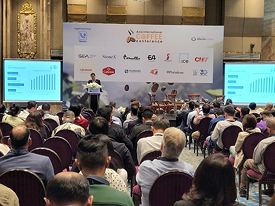
After 3 years of being affected by Covid-19, on December 5, the 27th Asia International Coffee Conference (Coffee Outlook) was held again in Ho Chi Minh City with the participation of more than 150 delegates from the International Coffee Organization (ICO), Coffee Associations of countries, corporations and businesses participating in the fields of coffee production, processing, import and export in Vietnam, as well as market experts, experts from certification and sustainable development organizations...
The conference is an opportunity for businesses to meet, exchange, connect, share information, update the current production status and the latest trends in the coffee market of the world's leading coffee producing countries, updating market trends and consumption growth potential of the coffee markets of China, India, Thailand, Philippines, Australia...
Speaking at the conference, Mr. Nguyen Nam Hai, Chairman of the Vietnam Coffee and Cocoa Association (Vicofa) assessed that the 2022-2023 coffee crop was a difficult and challenging crop for farmers and corporations and businesses participating in the chain of coffee production, processing, supply, service and import-export business. A crop year with many fluctuations in the global political and economic situation in the directioon creating more difficulties than advantages. Climate change and natural disasters also greatly affect productivity, output, and quality of coffee.
In that context, global coffee export in the 2022-2023 crop year declined because a global macroeconomic environment is not conducive to consumer confidence, rising inflation combined with high interest rates in many key economies, increasing the cost of living, thereby reducing usable income levels over the long term for much of the world. It is expected that coffee consumption in the 2022 - 2023 crop year is likely to only reach 178.5 million bags, a slight increase of 1.7% compared to the previous crop year.
Mr. Nguyen Nam Hai said that the new coffee year 2023 - 2024 had been going for 2 months and was forecast to continue to be a year with full of difficulties and challenges for the world coffee industry. Climate change with extreme weather events would greatly affect the global coffee supply: productivity and quality would decrease.
Vietnam is in the harvest season of the new crop year and has harvested an estimated 50% or more of the country's coffee output. Some areas harvested late due to rainy weather, and output will be much lower than expected. Due to the impact of climate change and crop conversion when coffee prices have been too low in recent years, Vietnam's coffee export in the first 11 months of 2023 decreased by nearly 13% compared to the same period in 2022. It is likely that Vietnam's coffee export will decrease by nearly 15% by 2023.
Mr. Do Ha Nam, Vice Chairman of Vicofa, Chairman of the Board of Directors of Intimex Group also said that the coffee area in Vietnam was narrwing in many key growing areas such as Dak Lak, Dak Nong... because people were switching to growing more profitable crops such as durian, avocado... “Each hectare of coffee currently brings in about VND 200 million in profit, while avocado trees bring in VND 1-1.5 billion, 5 times more than coffee. Therefore, it is very difficult to keep farmers with coffee trees”, said Mr. Do Ha Nam.
Mr. Nam added that according to data from the Ministry of Agriculture and Rural Development, Vietnam's coffee area as currently at 700,000 hectares, but in reality, it might only be over 600,000 hectares. Accordingly, in the 2023-2024 crop year, Vietnam's coffee output was expected to decrease slightly to about 1.6-1.7 million tons, compared to 1.78 million tons in the 2022-2023 crop year.
At the conference, domestic and international experts emphasized the need for sustainable development and green growth for the global coffee industry. Accordingly, from the beginning of the 2023 - 2024 crop year, the coffee industry must have an action plan to adapt to regulations against deforestation and forest degradation (EUDR), Carbon Border Adjustment Mechanism (CBAM) and European Union carbon certificate. The step-by-step implementation of these programs demonstrates the global coffee industry's responsibility to protect the environment, protect nature, and minimize the impact of climate change...
Source:Custom News
- Viet Nam’s trade surplus with EU expands amid economic headwinds
- Steel, cement and electricity firms to trade emissions quotas under Viet Nam's carbon market
- VCCI proposes 11 recommendations to quantify support for SMEs
- Trump’s copper tariff decision hangs over global metal market
- Global capital sees potential in Europe but calls for lighter regulation