


Most viewed articles


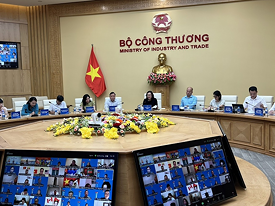
"We cannot continue to rely solely on processing; we need to take control of raw materials and all stages of product design," emphasized Deputy Minister of Industry and Trade Phan Thi Thang at the Trade Promotion Conference with Vietnam's overseas trade offices in August 2024.
According to Thang, Vietnam's textile and footwear industries have established a strong presence on the global stage. However, these sectors are now facing competition from various countries and challenges such as the growing trend toward green consumption and new regulations from several import markets. "We cannot continue to rely solely on processing; we need to take control of raw materials and all stages of product design," she reiterated.
Pham Tuan Anh, Deputy Director of the Department of Industry (MoIT), mentioned that in December 2023, the Vietnam Leather, Footwear, and Handbag Association and the Vietnam Textile and Apparel Association submitted a proposal to the MoIT seeking approval to establish a raw material trading center for Vietnam's fashion industry.
According to the Department of Industry's leadership, textiles and footwear are two of Vietnam's major export industries, with an average growth rate of over 10% per year. According to reports by the World Trade Organization and World Footwear Magazine, Vietnam is the world's second-largest exporter of footwear and the third-largest exporter of textiles.
Despite these achievements, Vietnam's textile and footwear sectors still primarily focus on processing, leading to low added value, and domestic companies contribute minimally. Most raw materials and accessories are imported from China, South Korea, and ASEAN countries.
According to the General Department of Customs, the import of raw materials for the textile and footwear sectors reached US$13.42 billion in the first six months of 2024, a 14.11% increase compared to the same period in 2023.
Dependence on imported raw materials could pose significant challenges for the sector's overall development, especially as major markets such as the U.S. and EU move toward Net Zero targets and impose stringent regulations on supply chain control, requiring products to meet high in-region origin standards.
The Department of Industry believed the establishment of the raw material trading center aligned with the government's strategy for developing the textile and footwear industries, as outlined in Decision No. 1643/QD-TTg dated December 29, 2022, and Resolution No. 115/NQ-CP dated August 6, 2020, which focus on promoting the development of supporting industries.
The center is expected to be funded through socialized capital and will gather both domestic and international raw material suppliers for the textile and footwear sectors. It will assist companies in tracing the origins of materials, facilitate business matchmaking, and showcase raw materials, technologies, and products in the textile and footwear industries. Additionally, the center will update businesses on trends and technologies in raw material production to support and promote domestic raw material production.
Phan Thi Thanh Xuan, Vice President and General Secretary of the Vietnam Leather, Footwear, and Handbag Association, remarked that the center would serve as a hub for the leather and footwear industries, helping businesses introduce and connect new products, test product quality, and meet market demands. It will also shorten the time needed for companies to source raw materials, thereby promoting the development of domestic raw material production.
Xuan proposed the need for favorable policies, streamlined procedures, and convenient transportation to ensure the center operates efficiently and fully supports the industry’s development.
Providing further details, Pham Tuan Anh mentioned that the Department of Industry has been working with the two associations to finalize the center's proposal, addressing key details such as its name, location, scale, structure, funding, and impact assessments. In October, the associations plan to send a delegation to China and other countries to learn from their experience in establishing similar centers, aiming to ensure the project is both practical and effective in the future.
Source: Customs News
- New-generation FTAs open wider export opportunities to Middle East and South Asia
- The new FTA provides a boost for Vietnamese goods to enter the Halal market
- Patents become new competitive weapon for cooperatives
- Resolution 10-NQ/TW marks significant upgrade in Viet Nam’s FDI approach
- DDG Nordquist: WTO remains the foundation of global trade despite growing challenges