
Most viewed articles


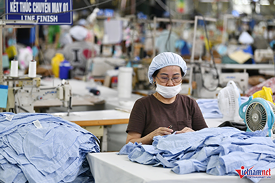
After only 2 years, Bangladesh has risen to the second position in the world in textile and garment exports. To survive and occupy the top position, the Vietnamese textile and garment industry with an export turnover of 40 billion USD must definitely invest and sacrifice for green production.
Lessons from Bangladesh
In fact, over the past 3 years, the textile market world decline in total demand due to the economy and the pandemic. In 2023, total textile demand will still decrease by about 5% due to geopolitical conflicts, decreased consumption due to inflation and high interest rates.
In that context, the world's top textile exporting countries such as China, Vietnam, and India witnessed a decline in export turnover, except for Bangladesh. This country still grew well, even reaching a record export turnover of over 4,6 billion USD/month (November-December 11).
Thanks to that, if in 2020, Bangladesh ranked third in the world in textile and garment exports after Vietnam and China with a turnover of 29,8 billion USD, then 2 years later it rose to second place in the world with a turnover of 49 billion USD, an increase of 64%.
Explaining the breakthrough in market share and market of Bangladesh, Mr. Le Tien Truong, Chairman of the Board of Directors of Vietnam Textile and Garment Group, said that since 2018, this country has invested a huge amount of money in production in the best, most modern, cleanest form, meeting the highest standards.
As of August 2024, there are about 230 LEED-certified factories here, of which 40% have achieved LEED Platinum - the highest green manufacturing standard in the US, set by the American Association of Building Contractors. Bangladesh has another 500 garment factories waiting to be assessed for LEED standards.
Along with stabilizing labor, improving quality and productivity, while still fully exploiting the advantage of cheap labor costs, the textile industry has maintained its growth momentum. According to Mr. Truong, this is a lesson for the Vietnamese textile industry.
Meanwhile, in Vietnam, factories that meet the Green Platinum standard are mainly located in the FDI sector, or large-scale Vietnamese factories such as Viet Tien. To date, Vietnam has 619 LEED-certified projects; of which only 10% are textile projects, out of a total of 13.000 textile enterprises with more than 50.000 factories nationwide.
Mr. Truong commented that this is a very modest number compared to the scale and requirements of the industry. Building and renovating factories to achieve green and sustainable certification is a big challenge for businesses due to financial investment requirements such as factory area, auxiliary areas, solar roof area, fresh air volume, green tree ratio in the factory premises, each paint color and material so that workers do not feel psychological pressure after 8-9 hours of work...
It is a matter of weighing the financial viability and operational realities of current plants.
Must invest sacrifices for green production
As one of the largest emitting industries with over 100 billion products per year, the amount of solid waste from textiles is currently over 90 million tons and will increase to about 150 million tons by 2030, of which only 20% can be recycled.
Therefore, the companies fashion Major economies around the world have responded to the emissions reduction program, with a roadmap of Net Zero (net zero emissions) by 0.
H&M, Levis, Uniqlo, Zara all have their own goals. For example, by 2025, H&M wants 30% of the materials used in its products to be from recycled sources, increasing to 2030% by 50. Adidas is also determined to have half of its products made from recycled materials by 2030.
At this time, there are no legal regulations on what percentage of recycled and circular products and renewable energy textile products must contain. However, once the trend and roadmap are set, there will be targets, goals and regulations in green standards that will be legalized, first of all in developed countries.
Therefore, both buyers and manufacturers are in the process of preparing so that when these standards are legalized, the supply chain is not interrupted or broken.
In Vietnam, the textile industry needs a 5-10 year roadmap. However, Mr. Le Tien Truong emphasized that if we do not urgently transform, when the standards and criteria become legal, our products will not be able to stand on the market, cannot be exported, which means we will have difficulty surviving.
This is something that business leaders must consider. If they want to develop sustainably in the next decades, they must definitely invest in green and sustainable production right now.
Therefore, in a recently issued resolution, the Vietnam National Textile and Garment Group (Vinatex) identified itself as “a destination providing complete solutions for green fashion”. To implement this strategic goal, the group has implemented a series of corporate restructuring solutions, including:
first, reorganize and divest businesses that are not part of the one-stop development strategy – that is, the ability to provide a complete solution from design to final garment product.
Monday, implementing innovation in production technology to ensure that it gradually meets the requirements of circular economy, green economy and digital transformation.
In the 4 years from 2021-2024, Vinatex focuses on innovating technology for fiber production, dyeing and textile production and energy used for production. Thereby, reducing 20% of electricity consumption per 1 kg of fiber (from 3,4 to 2,8kwh/kg), the dyeing industry reduces 15% of water consumption per 1m2. Rooftop solar energy is used for about 15% in the fiber industry, 30% in the garment industry of the total electricity consumed. About 25% of manufactured products are from recycled materials.
Tuesday, invest in product research centers.
Since 2020, three research and development centers have been established, focusing on researching highly circular products. Initially, the centers contributed about 3 million USD in order value.
Wednesday, Invest in research on special products other than regular textiles, thereby opening a new direction; according to the plan, by 2030, the revenue will reach about 60 million USD/year, with a profit margin twice as high as the current textile industry.
Final, forming a chain link from yarn - weaving - dyeing, finishing - sewing.
Source: Vietnam.vn
- Viet Nam, EFTA finalize negotiations on free trade deal
- Germany's energy-hungry small firms struggle with green shift
- Green foreign investment must be integrated into Europe’s clean industrial policy
- Türkiye leads global EU summit on clean industry cooperation to drive decarbonization
- Top leader orders removing bottlenecks to achieve GDP growth at least 10%