

Most viewed articles


The fragile tariff truce has spared Europe from Trump’s wrath and kept him on board on Ukraine so far — but at a reputational cost.
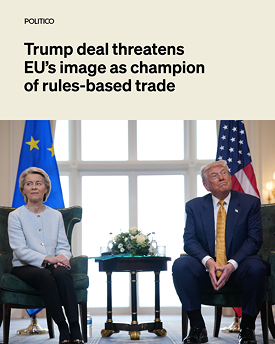
Most thumbs were up. Some smiles were uneasy. And, in the middle of it all, the EU’s top trade official, Sabine Weyand, wore the kind of look that told the whole story: The bloc had gotten itself into a tricky spot.
The photo, taken as the European Union and the United States sealed a fragile tariff truce at President Donald Trump’s Scottish golf resort on July 27, captured the discomfort on the European side over an agreement that was merely "the best it could get."
The two sides have finally firmed up Trump’s handshake deal with European Commission President Ursula von der Leyen into a joint statement that sets a 15 percent baseline U.S. tariff; promises a reduction in tariffs on European cars; caps levies on pharmaceuticals and semiconductors; and fully exempts EU exports of aircraft.
Throughout, Europe has been engaged in a delicate dance with Trump — seeking to hold him to his trade promises while its leaders lobby him to commit to security guarantees for Ukraine against Russian aggression.
“We’re still hostage to American military and strategic protection with a horribly neuralgic point, which is Ukraine,” said Pascal Lamy, a former EU trade commissioner.
“And if we laid into Trump, which we have the economic capacity to do, he would have been able to say: ‘Well, if Europeans are enemies, now I don’t see why I should continue to help Ukraine.’ Nobody wants to take responsibility for that.”
A less pressing, yet more awkward, task will be for Brussels to show the world it didn’t break the very rules of international trade that it helped to craft. After all, it has lectured Beijing, Washington and New Delhi for years on the importance of the World Trade Organization as an umpire of rules-based commerce.
“We have completely sat on the rules that we helped to create, together with the Americans, and we will be accused of continuing to undermine them in the future if things continue as they are,” said Lamy, who after his stint in Brussels went on to helm the Geneva-based WTO between 2005 and 2013.
Von der Leyen’s admission at Trump’s Turnberry golf club that the EU had a “surplus” with the United States that the deal would help “rebalance” was the last nudge the Trump administration needed to declare victory and bury a system it had long seen as obsolete.
Source: Politico
- US tariff threats over forced labour 'unjustified', Commission says
- US Section 301 Forced Labor Investigation: New Trade Compliance Risks for Viet Nam Exporters
- US cites forced labor concerns as grounds for new tariffs
- Aquatic products face challenge of maintaining market share in US
- Viet Nam extends anti-dumping duties on some Thai sugar products to 2031