


Green seaports face the challenge of logistics costs.
19/12/2025 97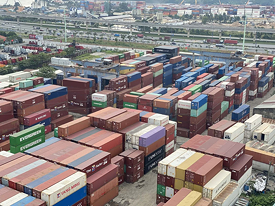
Most viewed articles


The energy transformation of seaports is becoming an essential requirement for Viet Nam to maintain its position in the global supply chain. However, in the context of Ho Chi Minh City's planned expansion of port infrastructure fees following the administrative merger, logistics costs are a major concern for the business community. This reality necessitates a green transformation roadmap that harmonizes the interests of the State, businesses, and society.
Pressure for green transformation of seaport systems.
At the workshop "Viet Nam's Port Energy Transformation: Challenges and Multi-stakeholder Cooperation," recently held in Ho Chi Minh City, participants unanimously agreed that green transformation in the port sector is no longer a voluntary trend but has become a mandatory condition for maintaining its ability to participate in global supply chains.
From the perspective of regulatory agencies, Mr. Hoang Hong Giang, Deputy Director of the Viet Nam Maritime and Inland Waterways Administration, believes that Viet Nam is facing a crucial choice. If the port system is not standardized and upgraded towards a greener direction soon, the risk of being excluded from international logistics chains is imminent. According to Mr. Giang, establishing green port standards and a shared data sharing system among stakeholders is fundamental to avoiding fragmented and unsynchronized development.
However, representatives of the regulatory agency also acknowledged that the energy transformation of seaports is a difficult problem for a developing economy . The lack of synchronized energy infrastructure, high investment costs, and long payback periods mean that implementation needs careful consideration to avoid creating a cost shock for the economy.
From a research perspective, Dr. Nguyen Son, a lecturer in Supply Chain Management and Logistics at RMIT University Viet Nam, argues that the core issue lies not in technology but in governance. According to Dr. Son, without a clear coordination mechanism between central government agencies, local authorities, and port operators, the transition process could easily fall into a situation where "each place does things its own way," leading to both increased costs and inefficiency.
Mr. Son emphasized that strategic targets for emission reduction need to be stable and transparent, but implementation must be flexible according to the conditions of each region and port cluster. "Green transformation cannot apply a single formula to everything, especially with port systems that have very different levels of development like in Viet Nam," Mr. Son said.
From these perspectives, it is clear that the State is playing a guiding and coordinating role, but careful consideration is also needed to avoid shifting all the costs and risks of the transition to the business sector – the force directly operating the port and logistics.
When logistics costs become a barrier
While the demand for a green transition is increasingly evident, the logistics business community is facing significant cost pressures. The proposal to expand port infrastructure fees in Ho Chi Minh City following its merger with Binh Duong and Ba Ria - Vung Tau has become a focal point of debate.
According to the draft, the total revenue from port infrastructure fees is expected to increase from approximately VND 2,100 billion per year to nearly VND 3,500 billion per year. Many industry associations believe that this increase will directly impact logistics costs, which are already high compared to the region.
Based on operational experience, Mr. Truong Nguyen Linh, Deputy General Director of VICT Port, said that port operating businesses are having to maintain continuous operation while preparing for green transformation. “Existing port infrastructure, especially older ports, cannot be upgraded overnight. If input costs increase, the financial pressure will be enormous,” Mr. Linh shared.
On a systemic scale, Colonel Bui Van Quy, Vice President of the Viet Nam Port Association and Deputy General Director of Saigon Newport Corporation, believes that to compete with ports in the region, Viet Nam needs to simultaneously transform its entire ecosystem: digitalization, greening, and procedural reform. However, he also emphasized that if logistics costs are pushed up too high, the competitive advantage of Vietnamese seaports will be eroded.
Representing GIL logistics company, Mr. Nguyen Huy Duc stated that many small businesses are in dire need of exemplary transformation models and policy guidance. According to Mr. Duc, businesses are not opposed to infrastructure investment or green transformation, but they need a clear roadmap and effective use of revenue, avoiding the situation of "paying fees first, then seeing the results later."
Associations such as the Ba Ria - Vung Tau Logistics and Port Association and the Viet Nam Association of Maritime Agents, Brokers and Services (VISABA) have also expressed concerns that expanding the fee collection could lead to overlapping costs, especially for goods transported by inland waterways, a method currently being encouraged to reduce emissions.
Conversely, local authorities argue that infrastructure fees are an important tool for reinvesting in transportation, reducing congestion, and improving logistics capacity in the long term. The challenge is how to design a transparent, fair fee policy that is closely linked to specific infrastructure projects, thereby gaining consensus.
Experts believe that the energy transformation of seaports can only succeed when three pillars—the government, businesses, and experts—participate and share responsibility. Without this balance, the goal of green seaports will be very difficult to achieve sustainably.
Source: Tin Tuc News
- USTR Makes Findings and Proposes Action in 60 Section 301 Investigations Relating to Failures to Take Action on Trade in Forced Labor Goods
- [VCCI] The US officially initiates a Section 301 Investigation into Vietnam on Intellectual property
- General Secretary and President To Lam's working visit to three ASEAN countries: Demonstrating the stature of proactive and constructive diplomacy.
- Viet Nam accelerates innovation drive as skilled workforce becomes key to science and technology growth
- The US is increasing controls on AI chip exports