


Most viewed articles


In 2025, exports of agricultural, forestry, and aquatic products are expected to set new records, exceeding $70 billion, far surpassing the $65 billion target and nearly $8 billion higher than the previous year.
According to the Ministry of Agriculture and Environment , the above results are due to many reasons, including proactively developing and implementing plans to respond to tariff developments, handling food safety incidents, removing technical barriers, and resolving cases related to durian exports to China...
Fruit and vegetable exports have made a spectacular comeback.
In the agricultural export landscape of 2025, fruits and vegetables continue to be a standout growth sector, bringing in $8.6 billion, an increase of nearly 20% amidst fluctuations. This marks the third consecutive year that fruit and vegetable exports have set new records and maintained double-digit growth.
According to the Viet Nam Fruit and Vegetable Association (Vinafruit), China will remain Viet Nam's largest fruit and vegetable export market in 2025, accounting for over 60% of the market share. Regarding the US market, despite the impact of tariff policies, fruit and vegetable exports to this market are still expected to increase by over 50%, reaching approximately $500 million.
In addition, exports to several major markets such as Japan, South Korea, the Netherlands, and Australia have maintained their growth momentum.
The main drivers of growth come from fruits such as durian, banana, mango, jackfruit, coconut, pomelo, etc., with durian continuing to play a leading role with export value of nearly 4 billion USD.
Speaking to Tuoi Tre newspaper, Mr. Dang Phuc Nguyen, General Secretary of Vinafruit, said that in the first quarter and the first half of the second quarter of this year, fruit and vegetable exports decreased by 30-50% compared to the same period last year due to China tightening control over residue levels of banned substances.
In addition, the news of the US imposing high retaliatory tariffs created negative sentiment among businesses, so at that time no one thought that fruit and vegetable exports for the whole year would reach the target of 7.6 billion USD.
However, thanks to the efforts of the Government, the Ministry of Agriculture and Environment, the Ministry of Industry and Trade , etc., who implemented flexible measures and organized delegations to China and the US for meetings, exchanges, and negotiations, a spectacular turnaround occurred in the second half of 2025.
"In early 2025, when China tightened controls on residues of banned substances like Yellow O and Cadmium, durian exports had to be temporarily suspended at times, or each container could take 7-10 days to clear customs."
The Ministry of Agriculture and Environment has had timely exchanges with the Chinese side to license testing laboratories, facilitating faster customs clearance procedures and helping to increase durian exports.
Subsequently, the ministry continued its negotiations with China to resolve issues, resulting in the approval of nearly 1,000 additional durian growing area codes and packaging facilities, as well as the establishment of a "green channel" mechanism for agricultural products.
"Viet Nam also promptly implemented measures to control cadmium and yellow O residues. This is the basis for the spectacular recovery and breakthrough in durian exports," Mr. Nguyen analyzed.
Another highlight is that fruit and vegetable exports to the European market increased by 40% last year compared to 2024. The number of food safety and hygiene violations was halved, to only 60 (mostly small, individual shipments).
"Europe is a market with strict technical barriers, so if businesses can export there, it will be easier to export to other markets," Mr. Nguyen affirmed, adding that the export value of fruits and vegetables reaching $8.6 billion was not "luck" because Vietnamese agricultural products such as coffee, pepper, cashew nuts, fruits and vegetables, rice, etc., are all experiencing sustainable growth, following the trend of low emissions and green practices.
"Without strong resilience, facing reciprocal tariffs from the US and technical barriers from countries like China and Europe, we would have fallen this year," Mr. Nguyen said.
Businesses that are agile and flexible.
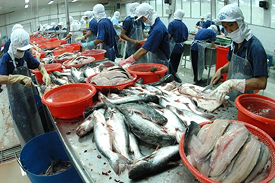
Not only did fruit and vegetable exports set a record, but seafood exports also reached a peak of $11.32 billion – the highest ever. Mr. Nhu Van Can, Deputy Director of the Department of Fisheries and Fisheries Inspection, commented that this result reflects the agility and flexibility of seafood export businesses in the context of the US imposing retaliatory tariffs and conducting anti-dumping investigations on shrimp...
"When there was news that the US was about to impose retaliatory tariffs, businesses pushed their goods forward, and when the tariffs were officially imposed, the export value gradually decreased in the last months of the year."
Another point is the shift in export markets. In the first 11 months of 2025, China surpassed Viet Nam to become its largest seafood export market, accounting for 20.2% of the market share, while the US dropped to second place, accounting for approximately 17%. Japan ranked third with a turnover of $1.6 billion," Mr. Can said.
Notably, lobster exports have surged (primarily to China).
According to the Viet Nam Association of Seafood Processing and Export (Vasep), the reason for the increase in imports of Vietnamese lobster is that we are not subject to retaliatory tariffs from China like Canada and the US, making our selling prices more competitive.
Furthermore, geographical proximity offers a significant advantage in transporting live seafood, helping to reduce losses and costs. Chinese consumer demand is shifting strongly towards blue lobsters – a segment in which Viet Nam has abundant supply.
"If there hadn't been damage from floods this year, the export value of lobster would have been much higher," Mr. Can said.
Ms. Le Hang, Deputy Secretary General of Vasep, said that when the US imposed retaliatory tariffs, Viet Nam's seafood exports underwent a significant adjustment. The Comprehensive and Progressive Trans-Pacific Partnership (CPTPP) is a major export driver thanks to tariff advantages and the stability of markets such as Japan, Canada, and Australia.
Exports to the EU also exceeded $1 billion, an increase of over 17%, with farmed seafood products having an advantage, while wild-caught seafood continues to be affected by the IUU yellow card.
The goal is to achieve export revenue of 73-74 billion USD in 2026.
Farmers will benefit even more in 2026 if the export target set by the Ministry of Agriculture and Environment is achieved: total export value of agricultural, forestry and fishery products reaching 73-74 billion USD.
To achieve this goal, the ministry said it will support connectivity, promote domestic processing and consumption, and implement solutions to address oversupply and price drops that harm producers.
Forecast and coordinate with localities to develop plans to support the timely consumption of key agricultural products. Coordinate the organization of agricultural product procurement connections, promote the consumption of agricultural products in large supermarket systems and chains, and organize forums to support the connection of agricultural product consumption... At the same time, we will open up new markets such as the Middle East and Africa...
From a sectoral perspective, Mr. Dang Phuc Nguyen stated that achieving $9-10 billion in fruit and vegetable exports in 2026 is entirely feasible because no new barriers have emerged yet. "In 2025, there were many barriers, but we overcame them. If there are any in 2026, they won't be able to pose a challenge."
The Chinese market remains the main market. Our ability to meet Chinese standards and regulations is improving. Furthermore, we recently signed an additional protocol for the export of fresh jackfruit; previously, we exported around $200 million worth of jackfruit annually, but this year that value could double.
Regarding the fisheries sector, Ms. Le Hang predicts that 2026 will remain a period of instability and unpredictability due to US tariff policies and technical barriers.
This trend simultaneously creates immense competitive pressure in other markets such as the EU, China, ASEAN, and the Middle East. Furthermore, the IUU yellow card remains a bottleneck that needs to be addressed.
To ensure the fisheries sector maintains double-digit growth in 2026, Ms. Le Hang believes that state management agencies and businesses need solutions to maintain market share in the US. For the EU, lifting the IUU yellow card remains a key task.
6 recommendations to help fruit and vegetable exports reach $10 billion.
To achieve $10 billion in fruit and vegetable exports – four years ahead of the target set in the fruit and vegetable processing industry development plan for the period 2021-2030 – Mr. Nguyen Thanh Binh, Chairman of the Viet Nam Fruit and Vegetable Association, proposed the following:
Firstly, focus on improving product quality and safety. This needs to be communicated and thoroughly understood by producers and businesses in the supply chain. We propose that specialized agencies strengthen their guidance, inspection, supervision, and enforcement of sufficiently strong sanctions to foster a sense of self-awareness among those involved in the supply chain.
Secondly, we need to complete a modern traceability system that can connect with the world to protect the rights of Vietnamese producers, consumers, and businesses.
Thirdly, improve the operation of the inspection, assessment, and certification system for exported agricultural products, ensuring fast customs clearance and the credibility of Vietnamese exports.
Fourth, continue promoting the image of Vietnamese fruits and vegetables both domestically and internationally.
Fifth, further strengthen trade promotion activities by increasing frequency, diversifying forms, expanding geographical areas, and increasing funding.
Sixth, the State supports the establishment of a research and development fund for the industry, aiming to seek and apply new and modern technologies for research and development of plant varieties, post-harvest technology, and preservation.
* Ms. To Thi Tuong Lan (Deputy Secretary General of Vasep):
"Seafood businesses are adapting flexibly to increase export value."
With regard to shrimp exports, many countries recognize Viet Nam as the fastest-diversifying shrimp exporting country in the world.
For example, India primarily exports shrimp to the US market, so when tariff issues arise, they are unable to adapt quickly. Vietnamese businesses, on the other hand, have managed to diversify their export markets to Japan, Europe, and several other countries.
Thanks to this, Viet Nam's shrimp exports remain very strong. Similarly, pangasius exports in 2025 are also expected to exceed the association's projections, reaching an export value of approximately 2.2 billion USD. Another noteworthy point is that in 2025, domestic seafood export businesses have effectively utilized the markets of CPTPP member countries.
In particular, many seafood export businesses have stepped up deep processing to increase export value, resulting in a nearly 60% increase in processed shrimp exports to the Japanese market. Thanks to deep processing, the seafood industry has not only maintained its market share but also increased its export value in 2025.
What seafood export businesses are worried about is that the final decision on anti-dumping duties on Vietnamese pangasius and shrimp (potentially as high as 35%) will be made by the end of the first quarter of 2026, which will put even greater pressure on the Vietnamese seafood industry.
Source: Tuoi Tre News
- USTR Makes Findings and Proposes Action in 60 Section 301 Investigations Relating to Failures to Take Action on Trade in Forced Labor Goods
- [VCCI] The US officially initiates a Section 301 Investigation into Vietnam on Intellectual property
- General Secretary and President To Lam's working visit to three ASEAN countries: Demonstrating the stature of proactive and constructive diplomacy.
- Viet Nam accelerates innovation drive as skilled workforce becomes key to science and technology growth
- The US is increasing controls on AI chip exports