

Most viewed articles


Green growth and sustainable development continue to be a prominent trend in the garment industry in 2025. This is a pressure but also brings opportunities for businesses.
High competition power
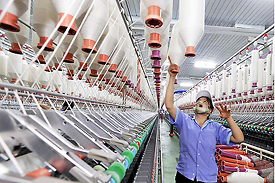
In 2024, Vietnam's textile and garment industry will reach the target of 44 billion USD, ranking 2nd world on export goods can be default. It is worth mentioning that in the chain of 12 competitive criteria, there are some criteria that Vietnamese garments are on par with, even surpassing the 'big guy' China, such as: Production quality, delivery time, flexibility in order quantity, innovation and ability to develop products together with buyers... It is worth mentioning that in the criterion of technical intensity/sustainability, Vietnam ranks first among the 6 countries exporting textiles and garments that can be the largest in the world.
According to analysis from the Vietnam Textile and Apparel Association, there are many factors that create the high competitiveness of the industry. In particular, Vietnam's politics and macro-economy are stable, with advantages in labor prices and skills compared to some countries; new-generation free trade agreements (FTAs) open up markets with large populations and high incomes (the Comprehensive and Progressive Agreement for Trans-Pacific Partnership (CPTPP) has 500 million people; the Regional Comprehensive Economic Partnership (RCEP) has 2.2 billion people); FTAs with a short tax reduction roadmap of 0% do not provide production and business results but also attract resources for developing domestic raw materials.
At the same time, Vietnam is in the process of improving the way it creates a more open business environment, which is also a good factor to attract investment, while promoting the production and export of garments in particular and goods in general.
Moving into 2025, forecasting remains a difficult task to define and many experimental formulas need to be continuously monitored and updated. The International Monetary Fund (IMF) also points out a number of risks that have a major impact on the development of the growth outlook in 2025, including: The risk of disruption/breakage of the chain also applies as a delay in the process before the conflicting monetary policies in the escalating regions; China's slowing growth (mainly due to the impact from the real estate sector) can create negative spillovers globally due to China's role in global trade; protectionist policies, trade war growth.
Vietnam economy is expected to maintain a steady growth rate in 2025. The additional US tariffs will create fewer orders for garments and textiles from China than usual, and this is a good opportunity for competitive countries, including Vietnam, to take the lead in receiving orders, including textiles and garments shipped from China if it can supplement the requirements on origin well.
Regarding the industry, Mr. Vu Duc Giang - Chairman of the Vietnam Textile and Apparel Association - informed that the orders are not worth mentioning. Many businesses have orders until the end of the first quarter of 2025, and are negotiating for the second quarter of 2025, however, the unit prices are determined to be low. In addition, the limitations of logistics infrastructure, shortages and competition for labor in production centers and large industrial parks are causing many difficulties for businesses in organizing production in the coming year.
" However, in 2025, Vietnam's textile industry can still achieve the target of 47 - 48 billion USD in export turnover, an increase of about 9% compared to 2024 ," Mr. Giang informed. At the same time, he said that this is a fairly standard target, in the context of green standards, sustainable development standards and experience.
From the business reality, Mr. Pham Quang Anh - Director of Dony Garment Company Limited - said that the business's goal in 2025 is quite modest compared to the 50% growth rate of 2024. As a result, like in 2024, the textile market in 2025 will not be stable, Dony's goal is to maintain a stable customer base, continue to research and invest in product optimization, reduce costs, and increase product competitiveness.
Persistent on sustainable development goals
Thus, in 2025, the forecast continues to forecast that some formulas of the textile industry, especially the quantitative transformation and green growth towards sustainable development goals, will continue to be in great demand. To achieve the growth target in 2025, the Vietnam Textile Association has identified 5 important solutions.
Firstly, in terms of investment, the Association attracts completely high-tech textile and garment projects to the industrial park; invests in the production of new types of natural, environmentally friendly raw materials; invests in specialized development.
Second, in terms of market, diversifying sources of chemical raw materials, customers, markets, and products; improving marketing capacity, finding direct customers; strengthening the transitional link from processed products to higher production methods; developing the economy and new products.
Third, in terms of human resource development, the association trains high-quality human resources for administration, technical management, design, new technology, digital transformation and green transformation.
Fourth is the solution for science and technology development, promoting research on the application of new environmentally friendly technologies, materials, and raw materials or technology transfer; comprehensive quality management; improving the capacity of research facilities and the quality of assets. Along with that, research on the application of digital transformation.
Finally, there are solutions for capital mobilization to build large industrial parks, wastewater treatment, rooftop solar power, fashion centers; develop green credit programs, design financial transformation of green technology, recycling; capital for developing domestic raw material crops (mulberry, jute, hemp, banana, sausage, etc.)
In the position of an enterprise, Mr. Dang Vu Hung - Key General Director of PPJ Group - believes that sustainable development is both an opportunity and a way to manage the formula for the enterprise. In terms of foundation, enterprises have the ability to produce optimal production processes; Check the level, reduce costs and input resources; Reduce emissions, create a solid foundation to build a complete circular economy...
However, to get those opportunities, businesses may have to solve the “problem” of costs for applying advanced technology in production, costs for green conversion. Along with that, how to adapt to changes in the market and users…
The solution to these problems, according to Mr. Dang Vu Hung, is for domestic textile and garment enterprises to strive to reduce resource consumption, limit environmental impacts; and balance net zero within the enterprise. At the same time, find a more closed solution to repeat the production product loop.
Source: Vietnam.vn
- USTR Makes Findings and Proposes Action in 60 Section 301 Investigations Relating to Failures to Take Action on Trade in Forced Labor Goods
- [VCCI] The US officially initiates a Section 301 Investigation into Vietnam on Intellectual property
- General Secretary and President To Lam's working visit to three ASEAN countries: Demonstrating the stature of proactive and constructive diplomacy.
- Viet Nam accelerates innovation drive as skilled workforce becomes key to science and technology growth
- The US is increasing controls on AI chip exports